221-2221? Really?
Can This Phone Number Really Change Your Life?
Part 1 ~ C
Everyone learns differently, and at their own pace. I get that.
But there's a difference between learning at a slow pace because they
CHOOSE to, and just plain learning forever slow
because . . .
They don't know that they don't know!
YOU are about to KNOW!
It is virually impossible for you to work this workshop and not dramatically
improve in a very short amount of time! It all depends on YOU! If you DO IT!
If you put in the time, and do each section as instructed, you will see
noticeable improvement within DAYS! Not months - NOT YEARS!
This workshop is kinda like a Roller Coaster ride!
It starts SLOW! But you need to go through this first part! But then . . .
It's ALL DOWNHILL!
And moves FAST! Stick with me! It gets FUNNER N FUNNER!
NOTE: The next time to come here to work, as if by magic, you will SKIP
all of the intro text below! And go directly to the actual hands-on part!
There is a huge gap most players just can't jump cross. And that gap is
costing you YEARS! It most likely already has! And the gap is the result
of ANOTHER GAP! It's called the Communication Gap!
And there are TWO kinds of communication that created the playing gap
you've been struggling with for years! Stick with me for a bit. You might
not like this next part. But you gotta hear it!
Communication Gap #1 . . . Student to instructor! I get it. For some, it
just isn't possible to get lessons from a qualified instructor. Different
reason for different people. So you decided to learn to play on your own.
And that's a tough road! But KUDOS to you for making the decision!
Communication Gap #2 . . . This one's partially the result of #1, learning
on your own. So much stuff out there. So much to learn. Chords, scales, rhythm,
timing, posture, hand & wrist position, finger placement, THEORY!
The problem is, because you're self-taught, no one has taught you to develop a
system of learning! No one has shown you this ONE really importantg part . . .
How to put it ALL together so it makes sense! And so you can practice in
a LOGICAL routine, not just ramble aimlessly, randomly!
So #2 is . . . you aren't communicating with yourself! Your brain! You can't
talk to yourself about stuff you don't know about! And most definitely -
you cannot talk about stuff you don't even know you don't know about!
You must have a developed game plan! A set routine! And it must include
ALL of the basics. But NOT RANDOMLY THROWN TOGETHER!
But how do you structure something that's all inclusive, if you don't fully
understand how it all fits together in the first place! The answer is simple . . .
You DON'T! And that results in taking YEARS to be able to do just the most
basic things! Like, hear a song, (even in your head) and figure it out!
It should NOT take you YEARS to learn how to play a couple hundred songs.
It should take MONTHS!
The big problem here is that you don't see the big picture! You hear a song,
you want to play it. But you can't find it online. Can't find the chords or
a book with the song. And you don't have a clue how to figure out the song.
So, you call up a buddy who's in a band. He's a solid player. You ask him
to help you learn it. He comes over. Sits on the couch, guitar in hand. You
start the recording. And before you can even get to your seat, he's PLAYING
THE SONG!
If you've been playing for a few months, you should be able to do that, too!
The reason you can't is . . . You don't understand how music WORKS!
This workshop is going to help you with that. We're going to "Put It All Together"!
When you've worked this workshop, and I mean WORK it! . . . You WILL be
able to figure out songs! Maybe not complicated songs. But MOST songs!
~~~~~~~~~~~~~~~~~~~~~~~~~~~~~~~~~~
When you begin the workshop below, some of you are going to say . . . Oh, I
know this stuff! But I guarantee you, YOU DON'T KNOW IT WELL ENOUGH!
Hmmm, you doubt me? Let me ask you this . . . If you're on stage at a jam
or a gig, and the band leader calls out a few numbers, says 2 or 3 words,
and sticks his hand up, with 3 fingers pointing straight up . . .
Will YOU know exactly what to play? What chords? What progression? Will you
even know what KEY to play in? (He told you when he stuck his HAND UP!)
There's stuff missing in your tool box! You have SOME of what's below.
But just "having" it in your tool box, and "knowing" how to use what, and when
is a WHOLE DIFFERENT THING!
So get ready to learn the missing elements that are holding you back from
PLAYING guitar! The things that are missing that hinder your ability to PLAY
SONGS! To JAM with friends! To GIG in a band!
~~~~~~~~~~~~~~~~~~~~~~~~~~~~~~~~~~~~~
There are really only a few things you NEED to know to be able to finally
see through it all, make that BREAKTHROUGH you've been praying for, for
so long! A few things that will literally TIE IN everything you know now,
with a few new things you'll learn here in a bit! And these few things are
SIMPLE NUMBERS!
We're going to work on a handful of NUMBERS! And once you get through this
workshop, you'll have that first major BREAKTHROUGH!
~~~~~~~~~~~~~~~~~~~~~~~~~~~~~~~~~~~~ >br>
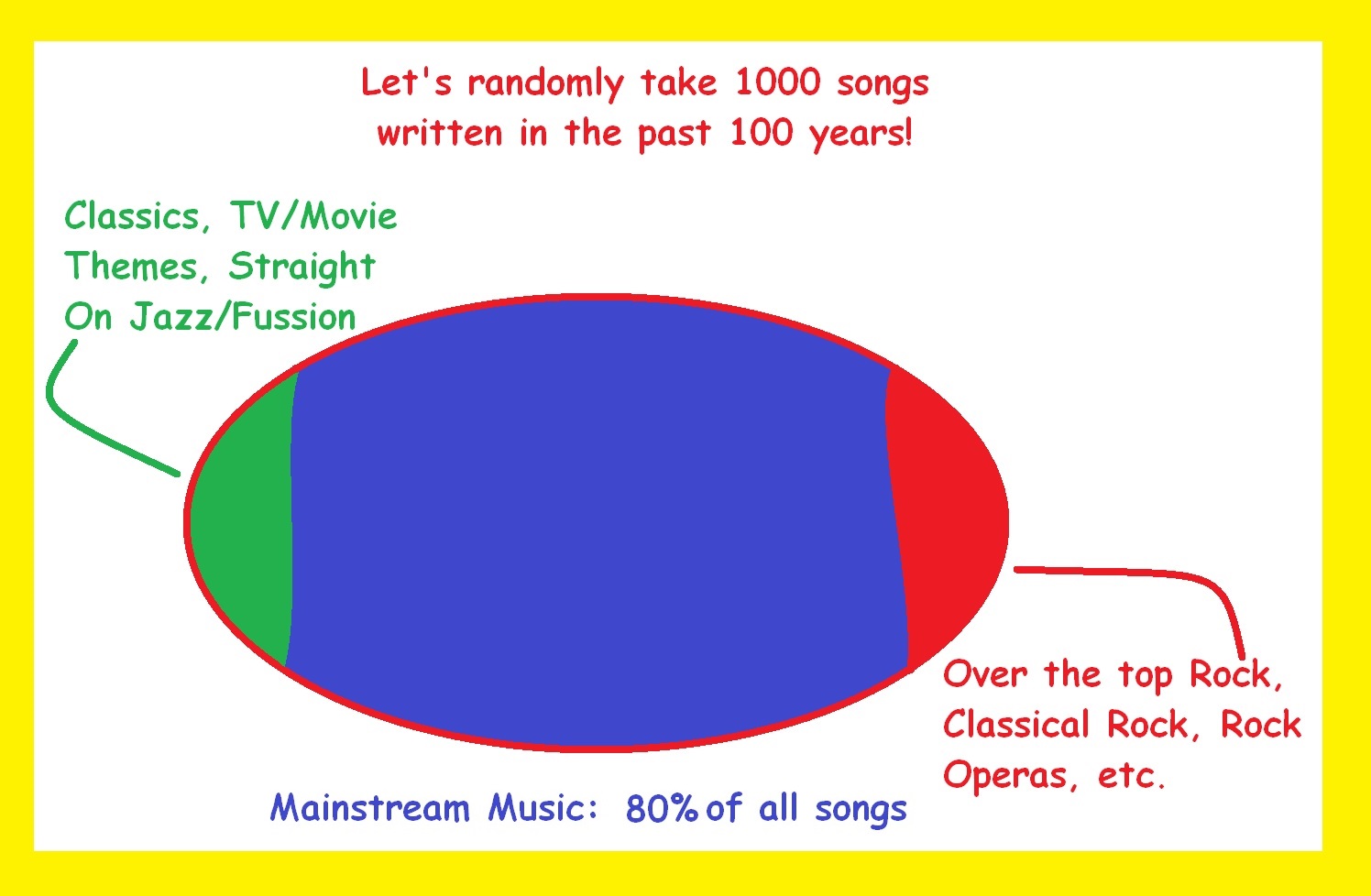
So, what all is a "song" about?
OK, the 80% is just a guess! But it's close enough!
Here's the thing . . . If we use the old 80/20 rule . . .
out of those random 1,000 songs . . .
EIGHT-HUNDRED OF THEM ALL USE THE SAMEBASICSTRUCTURE!
800 of them use the same 10 to 20 basic chord progressions! Same chords!
The same combinations of 3 or 4 chords! They are ALL ESSENTIALLY THE SAME!
Somewhere around 70% or so of ALL the hits from the 50s used the SAME THREE
CHORD PROGRESSIONS! Late 50s through the mid 60s, same thing!
Almost 100% of all Country hits use the same chords, same progressions! They
are ALL the SAME! The majority of all Blues songs, chord wise, are the same!
With some embellishments! All Blues songs are not 3 chord songs!
BUT . . . they use the SAME CHORDS AND SAME PROGRESSIONS!
It's exactly the same for Folk songs, Gospel, Good Ol' Rock n Roll!
Rock-a-Billy! You name it! IT'S ALL THE SAME!
YEAH, THE BASS PATTERNS VARY. THE DRUMS VARY A BIT! The melody varies
a bit. But with the exception of the lyrics . . . they're all the same!
I forget the actual number, but approx. 90% of ALL the hits in the 2000s
have been written by the SAME TWO GUYS! One company that cranks out hits!
They have a writing team. And they are all the same handful of chord progressions!
~~~~~~~~~~~~~~~~~~~~~~~~~~~~~~~~
So what we're going to do now is stop you from being a "guitar player" or
ANY instrument - and change you into a GUITARIST - A MUSICIAN! And there's
a HUGE difference!
I gave an example of the difference above. The musician sat on the couch and
figured out the song while the guitar player started the recording and sat down!
If you've read this far, I suspect you really want to move to the next level. If you
do, then WORK this workshop until you GET IT! Until you see the whole picture!
~~~~~~~~~~~~~~~~~~~~~~~~~~~~~~~~
Here We Go! The Numbers!
1 2 3 4 5 6 7
~~~~~~~~~~~~~~~~~~~~~~~~~~~~~~~~
If there was only one thing you had to do to be able to play just about
every song ever written, it would be . . .
RECOGNIZING CHORD PATTERNS!
Chord combinations! And the cool thing is, if you work on just 20 chord combos,
20 chord progressions . . . You will be well on your way! (6 will take you a LONG WAY!)
But, keep in mind, there are 12 keys! So your choices are to either learn
these 20 progressions in all 12 keys, or . . . learn how to transpose a song
into a key you already know!
But the thing is, both of these options are important! So what we're going to
do is, learn 3 keys, AND learn how to transpose! This is all a part of becoming
a musician, not a guitar player!
Here's why! if you were to start on day 1 learning say, 20 songs. And it took
you 6 months to get them down, then in 6 months you think you could say . . .
"I'm a guitar player". But you cannot! What you can say is, "I have a guitar,
and I can play 20 songs."
BUT . . . If, in that same 6 months, you learned how to play guitar, not play
songs, THEN you could say . . . "I'm a guitarist". And if someone asked you
"Hey, what songs can you play?" You could answer . . . "ALL OF THEM!"
This isn't going to be as difficult as you think! It's gonna be one step at
a time. And the steps aren't hard at all! Not if you follow this plan!
The 1st step isn't to learn a bunch of theory! The 1st step takes less than
3 minutes! But you gotta do it! You're going to listen to 2 simple tracks.
AND LET IT SINK IN! You must really LISTEN to them!
They're not polished jam tracks! Kinda crude. But the thing that's
important is that you HEAR the PATTERN! There is just 1 verse of 14
totally different sounding songs in the 2 tracks.
Your first exercise it to LISTEN. Each one of the songs sounds different.
Different bass pattern, different drum pattern. Different rhythm. Different
FEEL! BUT . . .
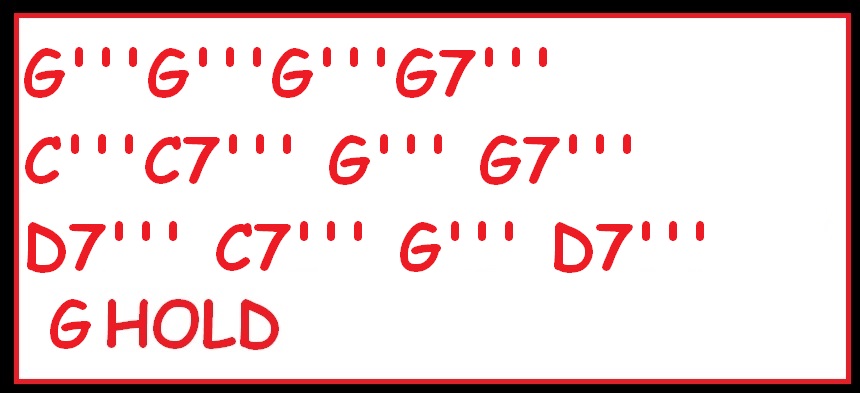
Each one, all of them have the same exact chord pattern! The pattern is called
a 1 4 5. One Four Five. I IV V. I'll explain that in detail after you listen.
But while you listen to each one, LISTEN for the chord changes!
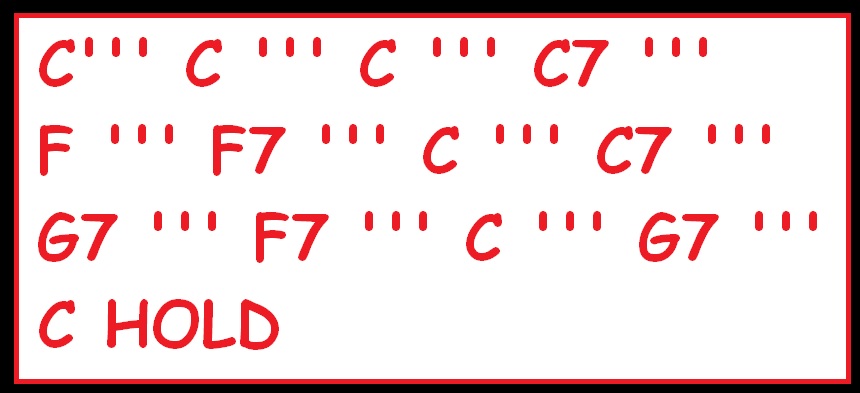
In ALL 14, the chords are . . .
While you LISTEN, follow along with the chords, and say them. Let the 1 4 5 SINK IN!
OK, here's the magic! In time, you won't call the chords in a progression by their
letter names! You'll call them by their NUMBERS! When you can do this, you
can play the progressions in ANY KEY!
So, this time, listen to track 2. More tunes. Different. But the same! And
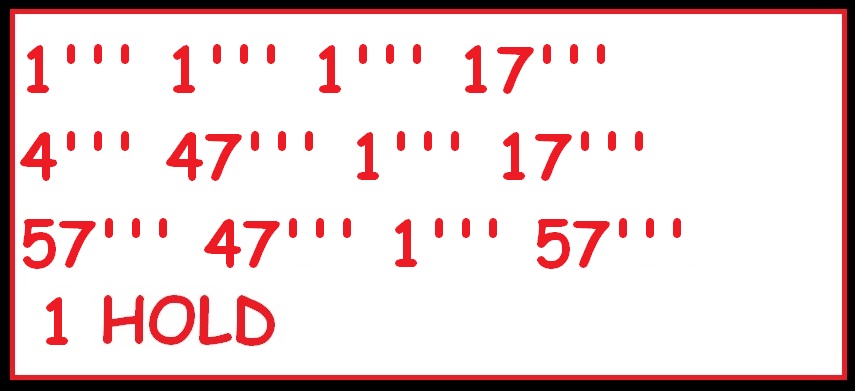
while you LISTEN, follow along with the NUMBER chart!
NOTE: C7 is the 7th form of C. Right? C is also the 1 chord in C.
So C7 is 17 ONE Seven. F is the 4 chord. F7 is 47 G7 is 57.
LISTEN, follow the chart. And CALL OUT the changes! One, one, one, one seven, etc.!
~~~~~~~~~~~~~~~~~~~~~~~~~~~~~~~~
Way To Go! Good job!
~~~~~~~~~~~~~~~~~~~~~~~~~~~~~~~~
OK, grab your guitar, and let's play some 1 4 5s! You might not play F
yet. or maybe not well. We'll soon fix that. But I'm pretty sure you know
G, C & D! So we're going to play a I IV V in G! A few of them, actually!
In each one, you'll play the same thing! The object at this point is ONLY
to get ONE FOUR FIVE burried into your cranium! Learn to recognize one when
you hear it! So let's go!
G 145 COUNTRY 145.mp3
G 145 COUNTRY BLUES.mp3
G 145 Pop Blues.mp3
REALITY CHECK UP: So, if you can 100% recognize any 145 when you hear it,
and if the majority of all songs are 145s, would it be a safe assumption that
when you hear a song, the majority of the time, it will be a 145 AND you can play it!
YES!
~~~~~~~~~~~~~~~~~~~~~~~~~~~~~~~~~~~~~
If you recognize the importance of the reality check up above, then you're
starting to get it! It really IS that SIMPLE! If you can hear a song, and
recognize the chord progression, the PATTERN, all you need to do next is
figure out what key it's in!
Your coaster car is about to roll over the peak!
~~~~~~~~~~~~~~~~~~~~~~~~~~~~~~~~~~~~~
OK, so most songs will be one of a small handfull of progressions. A HUGE
numbr of them will be just a FEW! 145, 1645 and 1625. Plus a couple minor
progressions. But what exactly are these numbers?!?
It's time to venture into the next step! Some basic theory! But just a little!
Remember the old Do Re Mi song you learned as a kid? That's the major scale. Do Re Mi Fa So La Ti Do in the key of C is C D E F G A B C. And each
note has a numeric value, called "degrees". C=1, D=2, etc. EZ so far, right!
The melody in a song is usually only made up from notes in the scale of the
key the song is in. IE: If a song is in the key of C, it has the notes of
the C scale. Another way to say it is . . . If the notes in a song are only
C D E F G A or B , then the song is in the key of C. 7 notes!
Chords are built using the notes in the major scale! And the chords played
will basically contain notes from the melody!
There are only 7 chords in a key. At least, only 7 chords in a key's Harmony
Chord Scale.
So, if you took just one key, and mastered it, could play the 7 chords, theoretically, you should be able to play ANY song ever written! Albeit, only in that one key!
There are songs that use chords outside of the key they're in. True enough! But the majority of all songs only contain chords in the key the song is in.
Also, the chords you occasionally find in a song that aren’t in the song’s key are only a “key away”! As in, if you knew a COUPLE keys, you’d also know many of the “other” chords in those songs.
And if you knew a FEW keys . . . you’d rarely even need more chords to cover every song ever written!
NOTE: I’m not including Jazz and Standards. But even most of those tunes can be played, and sound good, with less chords.
So, doesn’t it make sense to master a key or two from the beginning of your learning?
One more point, then On With The Show! Progressions! Look, there are only so many permutations of 7. So many combinations of the 7 chords.
OK, there are literally 1000s of permutations of 7. But musically speaking, there are only so many combos of 7 chords. Plus, MOST songs only use 3 or 4 chords!
SO . . . it also makes sense that if you learned a handful of chord progressions, (about 20!) all in one key, you could literally play 1000s of songs! And if you would learn just the main 4 chords of just TWO MORE KEYS,
you could play those 1000s of songs in THREE KEYS!
There is another related workshop that will have you playing ALL of the chords in 3 keys. And covers 20 chord progressions! These are the most used of all
chord progressions. And that workshop should be your NEXT one!
"Master the keys of C, G & D ! - PLAY 1,000 SONGS!
So, 7 chords in a key. The chord pattern is always the same.
Major minor minor Major Major minor Diminished
The key of C Major Scale is: C D E F G A B C
In the key of C we have . . . C Dm Em F G Am Bdim
Each chord is numbered logically. C being 1, Dm 2 etc. So a 1 4 5 would
be the 1st 4th and 5th chord of the chord scale. C F G. Generally, we us
Roman Numerals to show chord numbers. I IV V. Minors use lower case.
C=I, Dm=ii, Em=iii, F=IV, G=V, Am=vi, Bdim=VII°
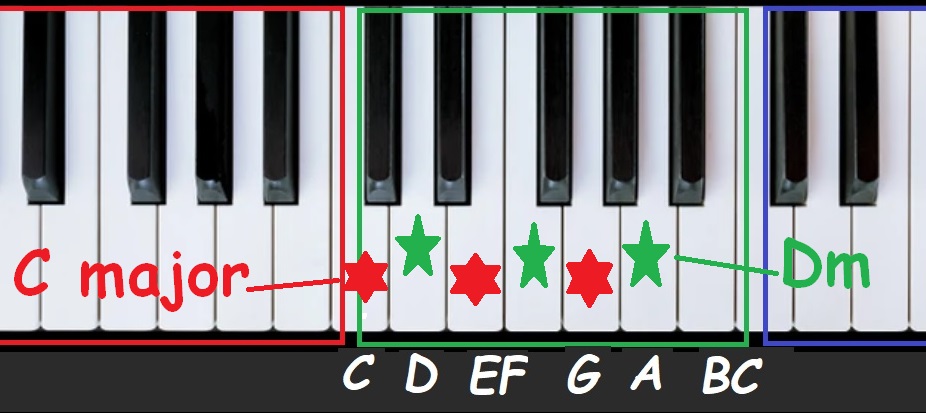
Making chords is actually EASY! You just start on a note, skip one, then skip
one more time. BINGO! Start at C, skip D, you have CE. Skip F, you have CEG.
CEG is a C major chord. Start at D and do the same thing. You get DFA, Dm. Etc,
So, on a string instrument, you change each string to a note in the chord
you want to play. C major: On guitar, you change the 5th string open A
to 3rd fret C. 4th string D to 2nd fret E. And B string to 1st fret C.
So all of the strings are playing a note in a C major scale.
These are all 3-note chords, called triads. We also have what's commonly
called the Jazz Harmony Scale. It's made up of 4 notes from the scale.
Adding the 7th note of the scale to the triad. All chords in the Jazz scale
are a form of 7th chords. C major 7th is CEGB.
In C they are . . .
Cmaj7 Dm7 Em7 Fmaj7 G7 Am7 Bm7b5
Generally, all the notes in the melody of a song are in the major scale
of the key the song is in. The melody will fall over chords made from
the same notes. So if you know just the 7 chords of a key, you can play
to just about any song, any melody in that key.
All of the exercises below have 2 audio tracks. One uses triads, the other, 7ths.
If you don't know the chords of the Jazz scale yet, you have two options.
1). Skip those tracks for now, and only work on the triad tracks.
2). Learn the chords now! And work on the tracks as you learn them!
Guess which one I suggest!
OK . . . here we go!
~~~~~~~~~~~~~~~~~~~~~~~~~~~~~~~~
This is where you'll jump to when you click the TOP upper link that says
SKIP THE INTRO TEXT. On your next vist, you can skip the above text.
We’ll work in the keys of C, G and D, The following are 6 of the absolute top played chord
progressions in C, G and D!
DRILLS: THE TRACKS START SLOW, INCREASE IN TEMPO EACH ITERATION.
Just go as far as you can in each one. You'll get farther each time
you work this workshop. You should work it for 60 to 90 days!
The object here isn't being able to PLAY these progressions. The object is . . . HEARING and ABSORBING the PATTERNS into your CRANIUM!
DRILLS
1
Key of C 251 (Widely used turn-around) 1C2Dm 3Em 4F 5G 6Am 7Bdim
Dm G C C
Key of G 251 (Widely used turn-around) 1G2Am 3Bm 4C 5D 6Em 7F#dim
Am D G G
Key of D 251 (Widely used turn-around) 1D2Em 3F#m 4G 5A 6Bm 7C#dim
Em A D D
~~~~~~~~~~~
PROGRESSIONS
2
1-4-5 (Happy)
C C C C7-F F7-C C7-G7 F7 C G7
6
C 6-2-3.mp3 (Same as Am 145 - Down Sad emotional)
Am /// Dm / Am / Em Dm Am Em
G 6-2-3.mp3 (Same as Em 145 - Down Sad emotional)
Em /// Am / Em / Bm Am Em Bm
D 6-2-3.mp3 (Same as Bm 145 - Down Sad emotional)
Bm /// Em / Bm / F#m Em Bm F#m
~~~~~~~~~~~~~~~~~~~~~~~~~~~~~~~
Part 2 on your journey to becoming a real musician!
Transposing keys! - It's honestly not hard!
This is actually as simple as using one of those toy decoding
rings, or toys when you were a KID!
Bookmark THIS page. Then click over to the SHORT Transposing tutorial!
It's a quick read, and shows you a simple way to transpose any song into any key!
Transposing Can Be EZPZ! CLICK HERE!
And there you have it!
It is virually impossible for you to work any of my workshops and not dramatically
improve in a pretty short amount of time! It all depends on YOU! If you DO IT!
If you put in the time, and do each section as instructed, you will see
noticeable improvement within DAYS! Not months - not years!
WORKING the workshop means doing ALL of the exercises! Don't skip any!
And . . . DO THEM IN ORDER! AND . . . do them OFTEN!
~~~~~~~~~~~~~~~~~~~~~~~~~~~~~~~
"NEW !"Master the keys of C, G & D ! - PLAY 1,000 SONGS!
~~~~~~~~~~~~~~~~~~~~~~~~~~~~~~~
OK, sit back a minute and think this over. Was it worth the time? Did
you learn anything you think you can use? Will it be fun? And one more
thing . . .
Are you starting to recognize chord patterns?
If the answer is YES to any of these questions, then please do 2 things.
1). Drop me an email. Or PM me on Facebook. Let me know what results you got!
2). DO THIS ALL AGAIN! But this time, it's gonna be WAY easier and faster!
Because you can skip over most of the text! Next time you come back to the
workshop, click the link at the very top of the page!
It looks like this . . .
Please feel welcome to contact me any time you have questions, or to
suggest a workshop topic! And comments are always welcome!
WORKING a workshop means doing it every day for 60 to 90 days. Or 60
to 90 practice sessions. You can do SOME every day. Start where you left off.
Or buckle down and do the whole workshop EVERY DAY for 2 to 3 months! You'll
be amazed at how much better you play guitar!
There are MANY workshops on the Wayne's Corner site! I hope you work a
bunch of them! There are also a bunch of tutorials! You can read them as
time permits! Check them out here . . .
My main Backing Tracks Support Website with 43,813
free bacing tracks! SoundFont, MIDI editors and players and
more! All distributed for free! Visit my MIDI ~ KAR ~ Backing Tracks Website
This site is free for all. The tutorials, workshops. 43,813 MIDI, KAR &
BIAB backing tracks files, 23 BIAB User Styles. A FREE SoundFont,
Timbres of Heaven. Free MIDI players and editor!
The fees for a site this large (Nearly 200 pages with over 50K files)
is pretty high, as you can imagine.
Please consider making a small donation to help keep us online. It
would help so much! Thanks! Wayne
PS: I pay for the site and all hosting, security and domain related
expenses out of pocket. Donations appreciated. Please click the link below.