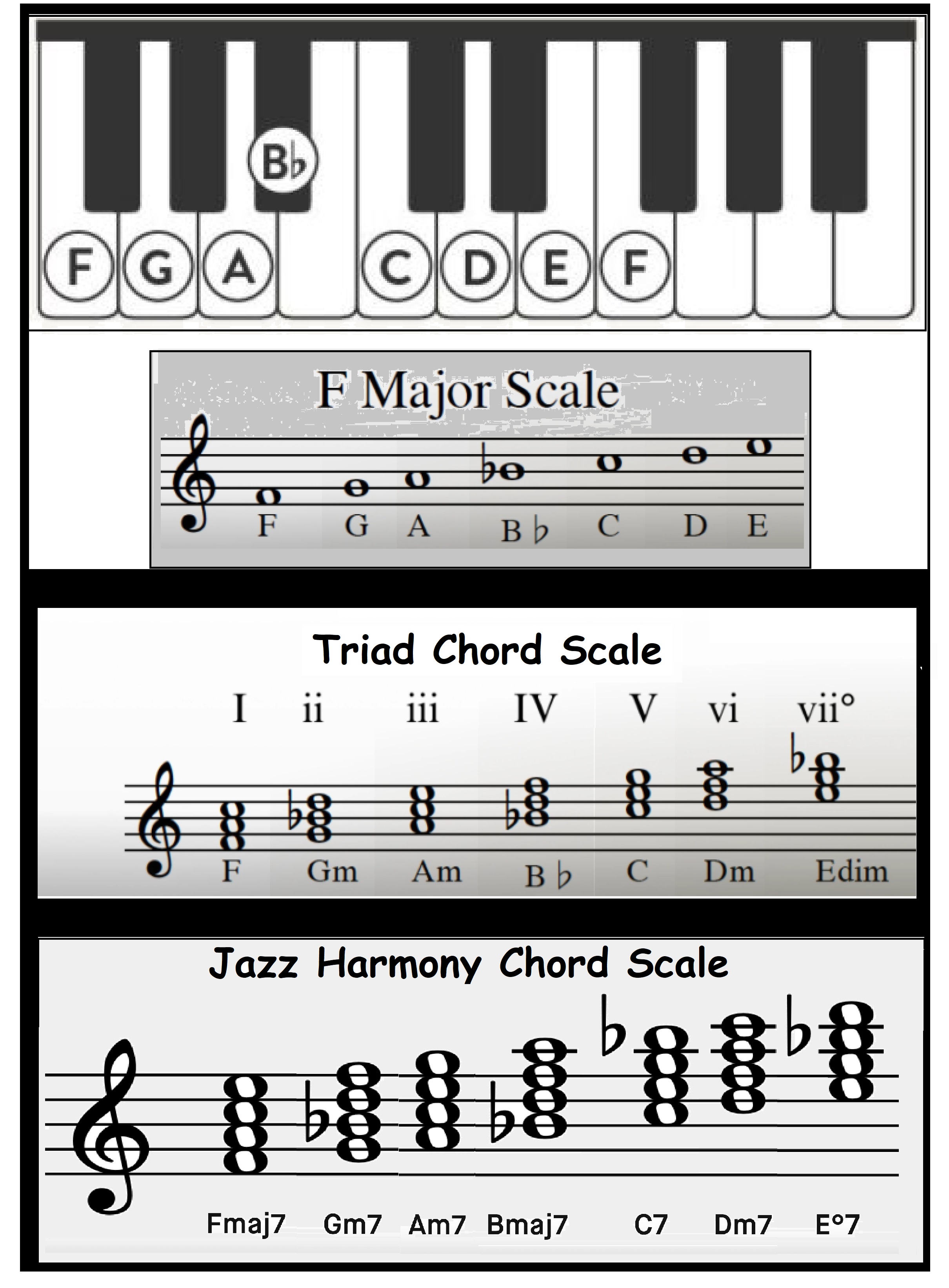
Key of F Tutorial/Workshop! The Progressions
OK, you made it through the exercises. I hope you CONTINUE WORKING ON THEM! Don’t
just work on the chord progressions! The object is . . . DRILL on the exercises! There are
only a few! Do them as your WARM UP! THEN , , , have fun with the following!
Here are progression examples. Play them the same way you played the chord exercises above!
SLOW, with a metronome. Until you can play them cleanly, smoothly and in time! Then gradually
increase the speed. If you play too fast and fumble . . . you are HURTING your progress! You
practice by playing correctly, not fumbling and messing up over and over! Speed will come!
OK, here we go! These aren’t “duplicates” of the songs! They’re “in the style of” audio
practice clips. So, they somewhat emulate some actual songs. But there are differences.
The bass lines and drum/percussion tracks are in time, and in key, but are not copied
from the actual songs! Also, I didn’t copy exact chord voicings! But the chords are correct
for the key, and “implied” melodies!
They will therefore sound very similar to actual songs you know! These are the progressions
used for 1000s of actual songs!
These are for your “practice” sessions, not rehearsals.!
NOTE: F ‘’’ is 4 counts. The F and the 3 ‘s . F ‘ would be 2 counts! F & ‘
8 bar I IV V/I V IV progression:
1 F ‘’’ F ‘’’ F ‘’’ F7 ‘’’ C7 ‘’’ Bb ‘’’ F ‘’’ C7 ‘’’ %
2 F ‘’’ Bb ‘’’ F ‘’’ F7 ‘’’C7 ‘’’ Bb7 ‘’’ F ‘’’ C7 ‘’’ %
3 F ‘’’ Bb ‘’’ C7 ‘’’ Bb ‘’’ F ‘’’ Bb ‘’’ F ‘’’ C7 ‘’’ %
12 Bar I IV V/I V IV progressions:
4 [: F ‘’’ F ‘’’ F ‘’’ F7 ‘’’ Bb ‘’’ Bb7 ‘’’ F ‘’’ F7 ‘’’
C7 ‘’’ Bb ‘’’ F ‘’’ C7 ‘’’ :] %
5 [: F ‘’’Bb ‘’’ F ‘’’ F7 ‘’’ Bb ‘’’ Bb7 ‘’’ F ‘’’ F7 ‘’’
C7 ‘’’ Bb ‘’’ F ‘’’ C7 ‘’’ :] %
6 [: F ‘’’Bb ‘’’ F ‘’’ F7 ‘’’ Bb ‘’’ Bb7 ‘’’ F ‘’’ F7 ‘’’
C ‘’’ C7 ‘’’ F ‘’’ F’ C7 ’ :] %
7 [: F ‘’’Bb ‘’’ F ‘’’ F7 ‘’’ Bb ‘’’ Bb7 ‘’’ F ‘ Gm ‘ Am ‘ Ab7 ‘
Gm ‘’’ Db ’ C7 ’ F ‘ Bb ‘ F ‘ C7 ‘ :] %
Minor Blues in F (Dm):
8 Dm ’’’ Dm ‘’’ Dm ‘’’ Dm7 ‘’’
Gm ‘’’ Gm7 ‘’’ Dm ‘’’ Dm7 ‘’’
Bb7 ‘’’ Am7 ‘’’ Dm ‘’’ A7 ‘’’ Dm ‘’’ Dm9 %
9 Dm ‘’’ Gm ‘’’ Dm ‘’’ Dm7 ‘’’
Gm ‘’’ Gm7 ‘’’ Dm ‘’’ Dm7 ‘’’
Am ‘’’ Gm ‘’’ Dm ‘’’ A7 ‘’’ Dm ‘’’ Dm9 %
10 Dm ‘’’ Dm/Db ‘’’ Dm/C ‘’’ Dm/B ‘’’ (Walk the low root note down
Gm ‘’’ Gm/Gb ‘’’ Gm/F ‘’’ Gm/Eb ‘’’ a half step each chord!)
Dm ‘’’ Dm/Db ‘’’ Dm/C ‘’’ Dm/B ‘’’
Am ‘ Am7 ’ Gm ‘ Gm7 ’ Dm ‘’’ A7 ‘’’ Dm ‘ Dm7 ‘ Dm%
Runaway
11 Dm ‘’’ C ‘’’ Bb ‘’’ A ‘’’ A7 ‘’’ %
Hit The Road Jack, Stray Cat Strut, etc.
12 Dm ‘ C ‘ Bb ‘ A ‘ Dm ‘ C ‘ Bb ‘ A ‘
Dm ‘ C ‘ Bb ‘ A ‘ Dm ‘ C ‘ Bb ‘ A ‘
Gm ‘ F ‘ Eb ‘ D ‘ Gm ‘ F ‘ Eb ‘ D ‘
Dm ‘ C ‘ Bb ‘ A ‘ Dm ‘ C ‘ Bb ‘ A ‘
Am ‘ G ‘ F ‘ E‘ Gm ‘ F ‘ Eb ‘ D ‘
Dm ‘ C ‘ Bb ‘ A ‘ Dm ‘ C ‘ Bb ‘ A ‘ Dm %
Let It Be
13 F ‘ C ‘ Dm ‘ Bb ‘ F ‘ C ‘ Bb Am Gm F ‘
Heartbreaker (Grand Funk Railroad) 123 123
14 Dm ’’ ‘’’ Dm ’’ ‘’’ C ‘’ ‘’’ C ’’ ‘’’ Bb ’’ ‘’’ Bb ‘’ ‘’’ Asus4 ’’ ‘’’ A7 ’’ ‘’’ %
Doo-Wop 50s progressions: I vi IV V
15 F ‘’’ Dm ‘’’ Bb ‘’’ C ‘’’ %
16 F ‘’’ Dm ‘’’ Bb ‘’’ C ‘ C7 ‘ %
17 F ‘’’ Dm ‘’’ Bb ‘’’ C ‘’’ F ‘’’ Dm ‘’’ Bb ‘’’ C ‘’’
F ‘’’ Dm ‘’’ Bb ‘’’ C7 ‘’’ F ‘ Bb ‘ F ‘ C7 ‘ %
Doo-Wop 50s progressions: I vi ii V
18 F ‘’’ Dm ‘’’ Gm ‘’’ C ‘’’ %
19 Gm ‘’’ Bb ‘’’ C ‘ C7 ’ F ‘’‘ % Gm9
20 F ‘’’ Dm ‘’’ Gm ‘’’ C ‘’’ F ‘’’ Dm ‘’’ Gm ‘’’ C ‘’’
F ‘’’ Dm ‘’’ Gm ‘’’ C7 ‘’’ F ‘ Bb ‘ F ‘ C7 ‘ %
16 bar Blues progressions
21 [: F ‘’’ F ‘’’ F ‘’’ F ‘’’ F ‘’’ F ‘’’ F ‘’’ F7 ‘’’
Bb ‘’’ Bb7 ‘’’ F ‘’’ F7 ‘’’
C7 ‘’’ Bb ‘’’ F ‘ Bb ’F7 ‘ C7 ’ :] %
22 23 Sorry, these were removed.
24 BAR Slow Blues
24 F ‘’’ F ‘’’ F ‘’’ F ‘’’ F ‘’’ F ‘’’ F ‘’’ F7 ‘’’
Bb ‘’’ Bb ‘’’ Bb ‘’’ Bb ‘’’ F ‘’’ F ‘’’ F ‘’’ F7 ‘’’
C ‘’’ C7 ‘’’ Bb ‘’’ Bb7 ‘’’ F ‘’’ F ‘’’ F ‘’’ F7 ‘’’
Mustang Sally in F would be:
25 F ‘’’ F ‘’’ F ‘’’ F ‘’’ F ‘’’ F ‘’’ F ‘’’ F7 ‘’’
Bb ‘’’ Bb ‘’’ Bb ‘’’ Bb ‘’’ F ‘’’ F ‘’’ F ‘’’ F7 ‘’’
C ‘’’ C7 ‘’’ Bb ‘’’ Bb7 ‘’’ F ‘’’ F ‘’’ F ‘’’ F7 ‘’’
Here are two more very common progressions! Used so much in Rock,
I don’t know if I can count the songs!
The first one is pretty easy. But it might not sound like the recorded hits.
Because the songs are heavily guitar centered, and use some guitar voicing
for the chords. But they’re a lot of fun to play, and very popular. The progression
is used on songs like Sweet Home Alabama, Can’t You See, Satisfaction, Last Time,
What I Like About You, Gloria, etc. And with one swap, one chord switch, there
are a bunch more! Like pretty much many of Neil Diamon’s songs! Cherry Cherry,
Thank The Lord For The Night Time, and a ton more.
26 C ‘’’ Bb ‘’’ F ‘’’ F ‘’’ % Sweet Home Alabama, etc.
27 C ‘’’ Bb ‘’’ F ‘’’ C ‘’’ % Can’t You See
28 C ‘’’ Bb ‘’ F % Satisfaction
29 C ‘’’ Bb ‘ F ‘ % Last Time
30 F ‘ Bb ‘ C ‘ Bb ‘ % Too many to list! Hang On Sloopy, Fever, etc.
31 C ‘ F ‘ Bb ‘ F ‘ % What I Like About You, Cherry Cherry, etc.
Another cool progression in F: NOTE: The A7 is substituted for the Am.
There are many songs that use this progression, from Fly Me To The Moon,
to Europa to Still Got The Blues For You. Each of those are in different keys.
Count this as 123 123 Gm ‘’ ‘’’ C7 ‘’ ‘’’ etc.
32 [: Gm C7 Fmaj7 Bbmaj7 Em7b5 A7 Dm Dm7 This is a SWEET progression!
Gm C7 Fmaj7 Bbmaj7 Em7b5 ‘ A7 ‘ Dm Dm7 :] % Dm9
If you arpeggiate it, you’ll end up playing this bad boy for HOURS!
OK, one more, but not all the chords are in F. And the song is actually in C (Am)
You play G not Gm, and A & A7 instead of Am & Am7.
But in F (Dm) it would be like this. Arpeggiate the chords! Guess the song!
When you figure it out, drop me an email with the name of the song!
wayneknazek1949@gmail.com
33 Dm F G Bb Dm F A A7 Dm F G Bb Dm A Dm A A7 Dm Dm DmMaj7
~
One more tool to add to your arsenal! Transposing! There’s an easy way to change
the key from one you’re not familiar with, to one you know really well!
Example: All of the exercises and progressions above! Once you have them nailed
in F, transpose them into another key, and practice all of them! Just go a step at a
time! And transpose all of the above. This is a GREAT WAY to learn more keys, and
to develop your transposing skills!
What you do is print out this Chromatic Scale. You can right click on the graphic,
save it as a file, then open it in something like Microsoft Paint (included in the
software). Then either print it out, or have it open on your PC or laptop.
You can just write it out as well! Be sure to go 2 full octaves! You’ll see why in
a bit!
Also, you need to write it out in sharps and flats! You’ll need BOTH!
C C# D D# EF F# G G# A A# B C C# D D# EF F# G G# A A# BC
C Db D Eb EF Gb G Ab A Bb BC Db D Eb EF Gb G Ab A Bb BC
Write out all of the chords in any progression or song you want to transpose.
Let’s use one of the progressions from above. 1624. F Dm Gm C
One thing you need to know is whether a key you’re going to has sharps or flats!
C has none! E F# G A D & B have sharps.
F Gb Ab Db Eb have flats.
So you wrote out F Dm Gm C C7. Let’s say you want to transpose this to the key of A.
F has 1 flat, Bb. But A has sharps! So use the sharp scale!
Count UP from F (the key you’re in) to A (The key you want to be in!)
How many half steps is it? 4! F > Gb G Ab A So you will add 4 half steps to each chord
in the key you’re in now.
C Db D Eb EF Gb G Ab A Bb BC Db D Eb EF Gb G Ab A Bb BC
C C# D D# EF F# G G# A A# B C C# D D# EF F# G G# A A# BC
F becomes A F > F# G G# A
Dm becomes F#m Dm > D#m Em Fm F#m
Gm becomes Bm Gm > G#m Am A#m Bm
C becomes E C > C# D D# E
C7 becomes E7 C7 > C#7 D7 D#7 E7
So F Dm Gm C in F becomes A F#m Bm E (E7) in A!
This is a cool way to get started! But here’s how you should really do it! 2 WAYS!
For someone still in the learning process . . .
You have a progression, or list of chords. You want to go from F to A. So . . .
Write out the chords in F, and number them. F=1 Dm=6 Gm=2 C=5
Write out an A major chord scale! And number them!
1=A 2=Bm 3=C#m 4=D 5=E 6=F#m 7=G#dim So, what is a 1624 in A?
A F#m Bm E
The best way! Once you practice this, over and over, you’re going to be
able to do this in your head. In time, you’ll be able to count in your head.
And/or, you’ll eventually be able to recall, or work out any major scale in
your head. You learn the pattern, and apply it.
Every major scale has the same pattern. The intervals between the notes are
the same for all keys. Whole step Whole Step Half Step Whole, Whole Whole Half.
WWH WWWH
So pick a note. Let’s do G. if you memorize the chromatic scale, this is really easy!
G up a whole step is A. Up a whole is B. Up a half is C up a whole is D. Up a whole
is E. Up a whole is F#. Up a half is G. G A B C D E F# G 145 is GCD. 1625 is G Em Am D.
Some people really prefer just using a transposition chart. That works as well!
OK, that’s it for this tutorial. Hope you dug it!
Back to Wayne's Corner Tutorial and Workshop Directory
Here's the theory tutorial in PDF format.
If you want it in a .doc or other Word format,
Click here and scroll to the bottom. Download the theory article.
Download which ever format you like. And read it. Just read it! In no time
you'll know more theory than probably anyone you know! Read it until you
GET IT! And you'll become the theory go-to guy or gal in your music circle!
Just 11 pages with a LOT of PIX!
If you're a musician, what ever the instrument, this will help you tremendously.
If you're a blues harp or harmonica player, you'll find this info the answer to
ALL of your questions. It's time for YOU to be IN THE KNOW!
Wayne (Reed) Knazek ~ Email Me Here! ~ My personal Web site
Join The MidKar Site Backing Tracks Support Group Forum
Search All Of MidKar Here ~ 43,736+ FREE Backing Tracks/
MIDI Files, KARS and BIAB files PLUS 23 User Styles. 256 pages!
MidKar Member's Site Directory
SITEMAP
Please help keep us online with a small donation!
This site is free for all. The tutorials, workshops. 43,813 MIDI, KAR &
BIAB backing tracks files, 23 BIAB User Styles. A FREE SoundFont,
Timbres of Heaven. Free MIDI players and editor!
The fees for a site this large (Nearly 200 pages with over 50K files)
is pretty high, as you can imagine.
Please consider making a small donation to help keep us online. It
would help so much! Thanks! Wayne
PS: I pay for the site and all hosting, security and domain related>
expenses out of pocket. Donations appreciated. Please click the link below.